Draught-proofing windows, including sash windows
Most people blame the glass when a window feels cold, but in older windows the glass is rarely the main problem. Historic England’s research found that more than three-quarters of the heat lost through a traditional window goes through the gaps round the opening parts, not through the pane.
That makes draught-proofing the first thing to try, well before replacing anything. It costs far less and keeps the windows you have. Research cited by Historic England found that draught-proofing can cut the air leaking through a window by between a third and a half.
What it saves
The Energy Saving Trust estimates that draught-proofing windows, doors and floors together saves a typical home in Great Britain about £55 a year, or £80 in Northern Ireland, and puts the cost of professional draught-proofing for a whole house’s windows and doors at around £250.
Windows that no longer rattle or whistle make a room quieter and less dusty too, and a room without a cold draught by the window is one you can use all evening.
Before you start
Leave trickle vents alone. Many windows have a slotted vent in the top of the frame. It is there to give the room a steady trickle of fresh air, and the Energy Saving Trust advises keeping it open. Draught-proof the gaps round the opening parts, not the vent.
Keep escape windows working. Upstairs, at least one window in a bedroom is often meant as a way out in a fire. Don’t seal or screw any window shut, and make sure any secondary glazing in front of it can be opened quickly without tools.
Watch for condensation. Sealing windows stops cold air coming in, but it also means less moist air gets out. If you notice more condensation afterwards, open the trickle vents, use extractor fans when cooking and bathing, and open a window for a few minutes each day. Condensation that doesn’t clear can lead to mould.
Find the gaps first. On a cold, windy day, run the back of your hand round each opening part, or hold up a strip of tissue and watch where it moves. Closing the window on a sheet of paper and pulling it out is a good test: if it slides out easily, that part isn’t sealing.
Casement windows
Casements are the windows that open on hinges, like a door. They are the easiest kind to draught-proof yourself.
- Check the window first. Tighten loose hinges and make sure the catch pulls the window firmly shut. A window that doesn’t close properly won’t seal, whatever you fit.
- Clean the frame where the opening part closes against it, and let it dry.
- Fit a compressible seal to the frame so it is squashed when the window shuts. Self-adhesive foam is the cheapest and suits small, even gaps, but flattens within a year or two. Rubber (EPDM) profile strips and wool strips last much longer and cope with uneven gaps.
- Do the paper test again once fitted. If the window is now hard to close, the seal is too thick.
For timber casements in older homes, a joiner can fit seals into a groove cut in the frame. They are almost invisible and last for many years.
Modern double-glazed windows
uPVC and aluminium windows already have rubber seals, so draughts usually mean something has worn or moved rather than that a seal is missing.
- Adjust the closing pressure. Most modern windows have small adjustable cams on the edge of the opening part that engage with keeps on the frame. Turning them pulls the window in tighter. The window’s manufacturer or a window repair firm can show you how.
- Replace tired gaskets. If the rubber seals are flattened, cracked or coming away, replacements are usually available and push into the existing groove.
- Check the hinges. A dropped window catches on the frame and leaves a gap along the top. Hinges can usually be adjusted or replaced without changing the window.
- Seal round the outside. Gaps between the frame and the wall need sealant, not draught strip. Old, cracked mastic outside is a common source of both draughts and damp.
Sash windows
Sash windows slide up and down, and that is why they are draughty: they need small gaps to move, and the gaps grow as the timber wears and the window settles. Air gets in at four points:
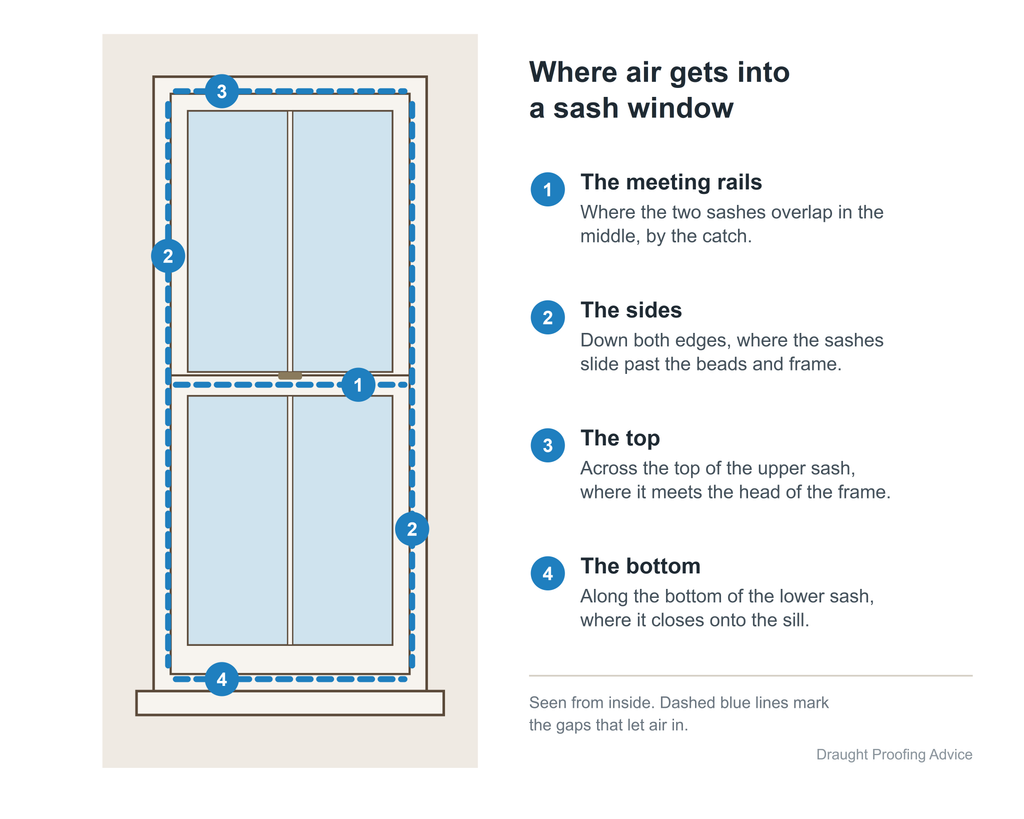
Professional draught-proofing is usually the best answer. A specialist takes the sashes out, repairs them, and fits brush or rubber seals into grooves cut in the beads, meeting rails and sash edges. The window still opens and closes smoothly, looks the same from outside, and stops most of the draught. It is often done at the same time as overhauling the sashes, renewing cords and freeing painted-shut windows, which is when it gives the best value.
Things you can do yourself:
- If the window is in good order and the gaps are even, fit a brush or compressible seal where the two sashes meet.
- Seal the bottom of the lower sash with a strip on the sill that the sash closes onto.
- Use removable sealing tape or cord in the side gaps of windows you don’t open in winter, taking it out in spring.
- Use internal shutters if the house still has them. Closed at dusk, they make a big difference and cost nothing.
- Add secondary glazing, a blind or lined curtains (see the next section).
Avoid anything that stops the window opening altogether, such as painting or screwing it shut. Sash windows need to open for ventilation, and in bedrooms for escape.
Adding a second layer
Once the gaps are sealed, a second layer on the inside of the window keeps more heat in and stops draughts from gaps you couldn’t reach. These suit any type of window.
| Option | How it works | Best for | Worth knowing |
|---|---|---|---|
| Secondary glazing | A second, separate window fitted inside the existing one, with an air gap between | Sash windows, listed and older homes, noisy roads | The most effective option. Can be fixed, sliding, hinged or lift-out. On a listed building, check consent first (see below). |
| Magnetic or clip-on panels | Clear acrylic or glass panels held on a frame fixed round the window | DIY secondary glazing on a budget; renters | Come off in summer. Make sure escape windows can still be opened quickly. |
| Window film | Clear plastic film stretched across the frame with tape and shrunk tight with a hairdryer | A cheap stopgap for windows you don’t open in winter | Lasts a season. Stops the window being opened, so not for escape windows. |
| Internal shutters | Hinged timber panels folded across the window | Georgian and Victorian houses that still have them | Close them at dusk. If they’ve been painted shut, they are often worth freeing. |
| Lined or thermal curtains | Heavy curtains with a thick lining | Any window | Close them at dusk. Tuck them behind radiators, not over them, so the heat goes into the room. |
| Cellular (honeycomb) blinds | Blinds made of pleated cells that trap air | Windows where curtains don’t suit | Fit them inside the window recess for the best seal. |
Older and listed homes
Original windows are often the most valued feature of an old house, and replacing them is rarely the best way to make it warmer. Historic England’s view is that traditional windows can almost always be repaired, even when they are in poor condition.
In its 2024 advice on adapting historic buildings for energy efficiency, Historic England says draught-proofing can usually be done with a negligible effect on a building’s significance, and that secondary glazing is generally acceptable. Slim double glazing set into historic frames can also be acceptable in some cases, if original glazing bars and historic glass are kept.
If your home is listed, any work that affects its character as a building of special interest needs listed building consent, and carrying out such work without consent is a criminal offence. Removable measures such as curtains, blinds and clip-on panels don’t need it. Fixed secondary glazing, routed-in seals and anything that replaces glass or timber often do, depending on the window. A few councils have issued local listed building consent orders that grant consent in advance for set works, such as internal secondary glazing on Grade II buildings, so ask whether yours has one. Speak to your council’s conservation officer before booking any work.
In a conservation area, draught-proofing and secondary glazing inside the house don’t normally need permission. Replacing windows can, particularly in flats, or where the council has made an Article 4 direction removing householders’ usual rights.
If you rent
Curtains, blinds, window film and clip-on panels that come away cleanly can usually be used without asking. Self-adhesive foam strips are generally fine too. For anything that involves drilling, routing or replacing parts of the window, ask your landlord first.
If windows are so draughty that rooms can’t be kept warm, or condensation is causing mould, that is a repair issue for the landlord to deal with.
Where to buy
Window seals, film and clip-on panels are sold by DIY stores and online. Sash draught-proofing and fitted secondary glazing are specialist jobs: look for a local firm with experience of older windows, and ask to see work they’ve done nearby. Examples, in alphabetical order:
- Chimney Sheep (wool door and window strips): chimneysheep.co.uk
- Selectaglaze (fitted secondary glazing, including for listed buildings): selectaglaze.co.uk
- Stormguard (foam, rubber and brush seals, window film): sold by most DIY stores
Chimney Sheep is the company that runs this site.
Sources
- Energy Saving Trust: draught-proofing
- Historic England: draught-proofing windows and doors
- RIBA Journal: Historic England Advice Note 18 on adapting historic buildings for energy efficiency (August 2024)
- Bidwells: local listed building consent orders for retrofit
- IHBC Context 188: consent orders and windows (June 2026)
Last checked 23 October 2026.